← Back to blog
Motionlab Blog
2D or 3D Motion Design: Which One Is Right for Your Project?
Antoine Vallet
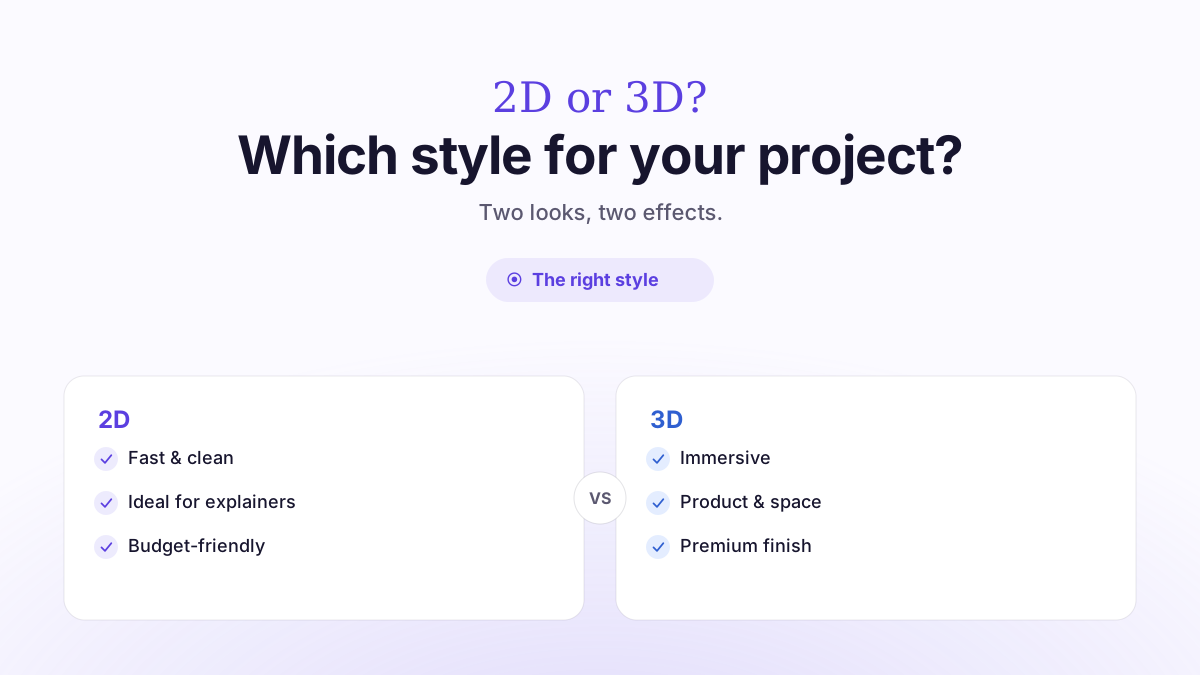
For most B2B projects, 2D motion design is the right choice: it explains an idea, a product or a service faster, with a budget starting at around €1,500 excl. VAT at Motionlab, compared with €6,000 excl. VAT per minute for 3D. 3D is only worth it when the volume, materials or realism of an object are central to the message. In other words, the decision is not about the most impressive look, but about what your audience needs to understand and the budget you can put behind it.
This article breaks the decision down point by point: what 2D and 3D really involve, the criteria that tip the scales, real costs and timelines, common mistakes, and the cases where a hybrid approach is the smartest move.
2D vs 3D: what are we actually talking about?
Motion design is the art of animating graphic elements to tell a story. The 2D / 3D distinction is about how those elements are built and how they move through space.
2D motion design
2D animates shapes, illustrations, icons, text and characters on a two-dimensional plane (height and width). It is the territory of motion graphics, explainer videos and interface animations. Its strength: clarity. An icon, a rising curve or an animated app screenshot can convey an abstract idea (a data flow, time saved, a SaaS feature) in a few seconds, without visual overload. It is the dominant style for presentation videos and product explainers.
3D motion design
3D builds objects in a three-dimensional space (height, width, depth) that the camera can move around. It involves its own set of steps: modeling, texturing, lighting, then rendering. Its strength: volume, materials and realism. It excels at showing a physical product from every angle, revealing the inside of a mechanism or creating a high-end brand world. The trade-off: every added step calls for specific skills and computing time, and 3D rendering can take hours of machine processing for just a few seconds of footage.
The 5 criteria that decide for you
Rather than choosing based on taste, rely on five objective criteria. In most B2B projects, four out of five will point to 2D.
The nature of your message. Are you explaining a concept, a piece of software, a service or a process? 2D is made for that. Do you need to show a physical object, its shape, its texture, its inner workings? 3D has the edge.
Your product. A SaaS product, an app or a platform has no volume to show: 2D is enough and gets straight to the point. An industrial object, a medical device, packaging or a technical part benefits from being seen in three dimensions.
Your budget. This is often the deciding factor: 3D costs several times as much as 2D for the same length.
Your timeline. 2D is faster to produce. An ambitious 3D project involves modeling and rendering, which means a longer schedule.
Your positioning. If your brand is built on an ultra-premium or high-tech image and the budget allows, 3D can create a strong point of differentiation.
Comparison table: 2D vs 3D at a glance
Criterion | 2D motion design | 3D motion design |
|---|---|---|
Best for | Explaining a concept, a SaaS product, a service, a process | Showing a physical object, volume, materials |
Key strength | Clarity, ease of understanding, speed | Realism, immersion, premium feel |
Budget (Motionlab benchmarks) | From €1,500 excl. VAT | From €6,000 excl. VAT / minute |
Production time | Shorter | Longer (modeling + rendering) |
Changes | Flexible and fast | More involved once modeling is done |
Typical B2B use cases | Explainer video, onboarding, social media | Physical product demo, brand world, industrial sector |
How much does each option cost, and why?
The price gap between 2D and 3D is not arbitrary: it reflects a real workload. At Motionlab, a video costs between €1,500 and €8,000 excl. VAT depending on length and style, with 2D starting at €1,500 and 3D at €6,000 excl. VAT per minute. The same gap shows up across the French market: agency guides put a minute of professional 2D in the range of a few thousand euros, while 3D starts significantly higher and can cost several times as much.
The reason lies in the process. 2D moves through script, storyboard, illustration and animation. 3D adds object modeling, texturing, scene lighting and machine rendering time that ties up specialized hardware and software. Each extra step means another skill to bring in and more billable time. For a full overview of pricing by length and style, check out our dedicated guide: how much a motion design video costs in 2026.
The impact on timelines
The same logic applies to the schedule. A 2D video is delivered faster than an equivalent 3D project, because it skips the modeling and rendering phases. At Motionlab, both 2D and 3D come with 10-day delivery for standard formats, but a very ambitious 3D project (a complex world, many objects) naturally requires more preparation. To plan your schedule, see our guide on how long it takes to produce a video.
The most common mistakes
When the choice between 2D and 3D goes wrong, it is usually for the wrong reasons. Here are the pitfalls to avoid.
Choosing 3D to "look more impressive". Beautiful 3D that adds nothing to the message adds cost and time without improving understanding. If your product is software, 3D can even muddy the message.
Underestimating the power of 2D. Polished 2D, with a strong script and real sound design, is often more memorable and converts better than average 3D. Clarity beats spectacle.
Forgetting where the video will run. A video made for LinkedIn or Instagram has to be readable in a few seconds and often without sound; 2D is more at home there. See our best practices for social media.
Putting technique ahead of the script. Whether the video is 2D or 3D, the script is what makes the difference. No technique can rescue a poorly built message.
What if the best answer is "both"?
The "2D or 3D" question assumes an either/or choice, but a hybrid approach is often the most cost-effective solution. A video built on explanatory 2D that includes a few 3D sequences (to show a product from every angle, for example) combines the clarity of 2D with the impact of 3D while keeping the overall budget under control. You save 3D for the moments where it truly adds value instead of making the whole video carry its cost.
This reasoning ties into a broader question: motion design versus live-action filming. If you are still unsure about the underlying technique, read our comparison of motion design and live-action video.
What about Motionlab?
Motionlab is a French motion design agency based in Paris, specializing in SaaS companies, startups and agencies. We produce both 2D and 3D, and our first job is to help you choose the right option for your message and budget, not the most expensive one by default.
Every project is handcrafted by qualified French motion designers, with nothing AI-generated, and includes the script, storyboard, voiceover, licensed music and sound design. We deliver in 10 days, with unlimited revisions and a free quote, in 16:9, 1:1 and 9:16 formats. Our pricing benchmarks are clear: from €1,500 for 2D, from €6,000/minute for 3D, with a 60-second video most often falling between €3,000 and €4,500 excl. VAT. This approach has earned us a 4.9/5 rating across 44 reviews and the trust of more than 65 clients.
FAQ: 2D or 3D motion design
Is 3D always more expensive than 2D?
Yes, for the same length and quality. At Motionlab, 2D starts at €1,500 excl. VAT and 3D at €6,000 excl. VAT per minute. The gap comes from the modeling, texturing and lighting steps, plus the rendering time specific to 3D.
Does 2D look "less professional"?
No. 2D is the standard for B2B explainer videos and SaaS videos precisely because it is clear and effective. Well-written, well-animated 2D often outperforms average 3D.
When is 3D truly essential?
When the volume, materials or realism of a physical object are part of the message: a demo of a tangible product, a cutaway view of a mechanism, a very high-end brand world with a budget to match.
Can you mix 2D and 3D in the same video?
Yes, and it is often the best compromise. An explanatory 2D base with a few targeted 3D shots delivers the impact of volume where it counts, without blowing the budget for the whole video.
Which style works best for social media?
2D is generally a better fit: it reads quickly, stays clear on small screens and works even without sound. 3D can add an element of surprise, but it is more expensive for content with a short shelf life.
Does price also depend on length?
Yes. Length is a major factor, for 2D and 3D alike. To decide between 30, 60 or 90 seconds, see our guide on the ideal length for a presentation video.
Take the next step
The best way to decide between 2D and 3D is to start from your message, your product and your budget, not from an aesthetic preference. At Motionlab, we point you to the most effective option, with a free quote, 10-day delivery and unlimited revisions.
Book a free discovery call and walk away with a clear recommendation, 2D or 3D, tailored to your project.
Got a video project to figure out?
Let’s talk about your next video and find the right angle.
Talk about my project